Hendrick Goltzius was a Dutch engraver and painter whose astonishing technical skill shaped the work of his contemporaries and generations beyond. Today, we’ll look closely at two of his signature engraving techniques, the swelling line and the dot and lozenge method, exploring how they are executed, what visual effects they create, and examining some magnificent examples of his engravings. Let's go!

Tantalus, by Hendrick Goltzius, 1588
Hendrick Goltzius (January or February 1558 – 1 January 1617) was a German-born Dutch printmaker, draftsman, and painter. He was born into a family of working artists; his father was a glass painter, and both his grandfather and great-grandfather were painters, and image-making was embedded in daily life.
After training with Dirck Volckertszoon Coornhert, he settled in Haarlem in the late 1570s, where he established one of the most influential print workshops in the northern Netherlands. By 1582, he had set up his own publishing business, enabling his studio prints to circulate well beyond Haarlem. Around him gathered artists such as Jacob Matham, Jan Saenredam, Jan Muller and Jacques de Gheyn II, all of whom would carry elements of his technical discipline into the next generation.

Homo Bulla, by Hendrick Goltzius, 1590
How the Swelling Line Creates the Illusion of Volume in Engraving
Engraving is a medium defined by incision; a burin cuts grooves into a copper plate, ink settles into those grooves, and damp paper is pressed into them, so that the image emerges in black against white. Without colour or wash, tone and volume must be constructed entirely through the control of line and the strategic use of untouched paper.
By the sixteenth century, engravers had developed efficient systems for generating shadow, typically by laying parallel lines across one another at measured angles to form dense grids. These systems were practical and repeatable, which made them highly effective for a growing print market.
The swelling line introduces a more elastic approach. Rather than maintaining a uniform stroke, the engraver varies pressure during a single cut, so that a line widens and narrows along its path. This widening is not accidental; it is used to model form, allowing a stroke to carry more visual weight at one moment and less at another.

Icrarus by Hendrick Goltzius, 1588
In Goltzius’ engravings, such as Icarus and The Great Hercules, the subject’s bodies seem to gather mass through these shifting strokes. Muscles swell through lines that broaden across their fullest points and taper as they turn away from the light. In some areas, contour becomes secondary, since the edge of the figure is implied by the accumulation and thickening of strokes rather than by a firm enclosing outline.
Because the lines themselves perform more of the modelling, fewer lines are required, leaving more of the white paper visible and intensifying the sense of illumination. From a distance, the figure appears rounded and cohesive, yet up close, the viewer can follow each incision and sense the deliberation behind it.
Technically, such swelling can be achieved by increasing pressure as the burin moves through the plate, cutting a deeper, darker groove. For more pronounced emphasis, a section of a line may be reworked to broaden it further. Practical limits exist, since excessively wide grooves do not retain ink cleanly during wiping, so engravers sometimes cut two closely placed strokes that print as a single, thicker line.
Goltzius did not originate this technique, but from the mid 1580s onward it became increasingly prominent in his engravings, where it appears more exposed and more assertive than in earlier examples. Through it, line becomes capable of conveying weight, tension and even a sense of movement, without abandoning the discipline of engraving.
For further insight, we recommend reading: Pollack, Susanne. “Swelling Lines: Cornelis Cort, Agstino Carracci, Hendrick Goltzius, and the Expansion of Engraved Line Systems in the Sixtheenth Century.” Crossing Parallels. Agostino Carracci and Hendrick Goltzius, 2021.
For further insight, we recommend reading: Pollack, Susanne. “Swelling Lines: Cornelis Cort, Agstino Carracci, Hendrick Goltzius, and the Expansion of Engraved Line Systems in the Sixtheenth Century.” Crossing Parallels. Agostino Carracci and Hendrick Goltzius, 2021.

The Great Hercules, by Hendrick Goltzius, 1589
How the Dot and Lozenge Technique Refines Light and Shadow
Traditional cross-hatching produces small diamond-shaped spaces where intersecting lines leave openings in the grid. These shapes, known as lozenges, are typically left untouched, with tonal value determined solely by the density of surrounding lines.
In Goltzius's engravings, those spaces often become active components of the shading system. Instead of leaving them empty, he placed small dots at their centres, subtly modifying the tonal balance of the surrounding network. A clear example is in his work Apollo. On the figure's torso, the lozenges formed by crossed swelling lines are interspersed with dots that moderate the transition from dark to light. The dots are not decorative. They regulate how the eye moves across the surface, softening what might otherwise feel like a rigid grid of intersecting strokes.

Apollo by Hendrick Goltzius, 1588
The intervention is modest but effective. Rather than adding another full layer of hatching, tone is adjusted from within the existing structure, allowing shadows to deepen and transitions between light and dark to feel more gradual. The result is a surface that appears less rigid and more responsive to curvature and illumination.
When viewed closely, the underlying order of intersecting lines and carefully positioned dots is clear. From a greater distance, however, the eye merges these elements into richer midtones that avoid the heaviness sometimes associated with dense cross-hatching.
Used in conjunction with the swelling line, this method expands the expressive range of black ink on white paper. One technique builds volume through variation in line width, while the other refines tonal transitions through small, controlled marks embedded within the grid itself. Together, they allow engraving to achieve a level of subtlety that feels unexpectedly fluid for a medium built on incision.

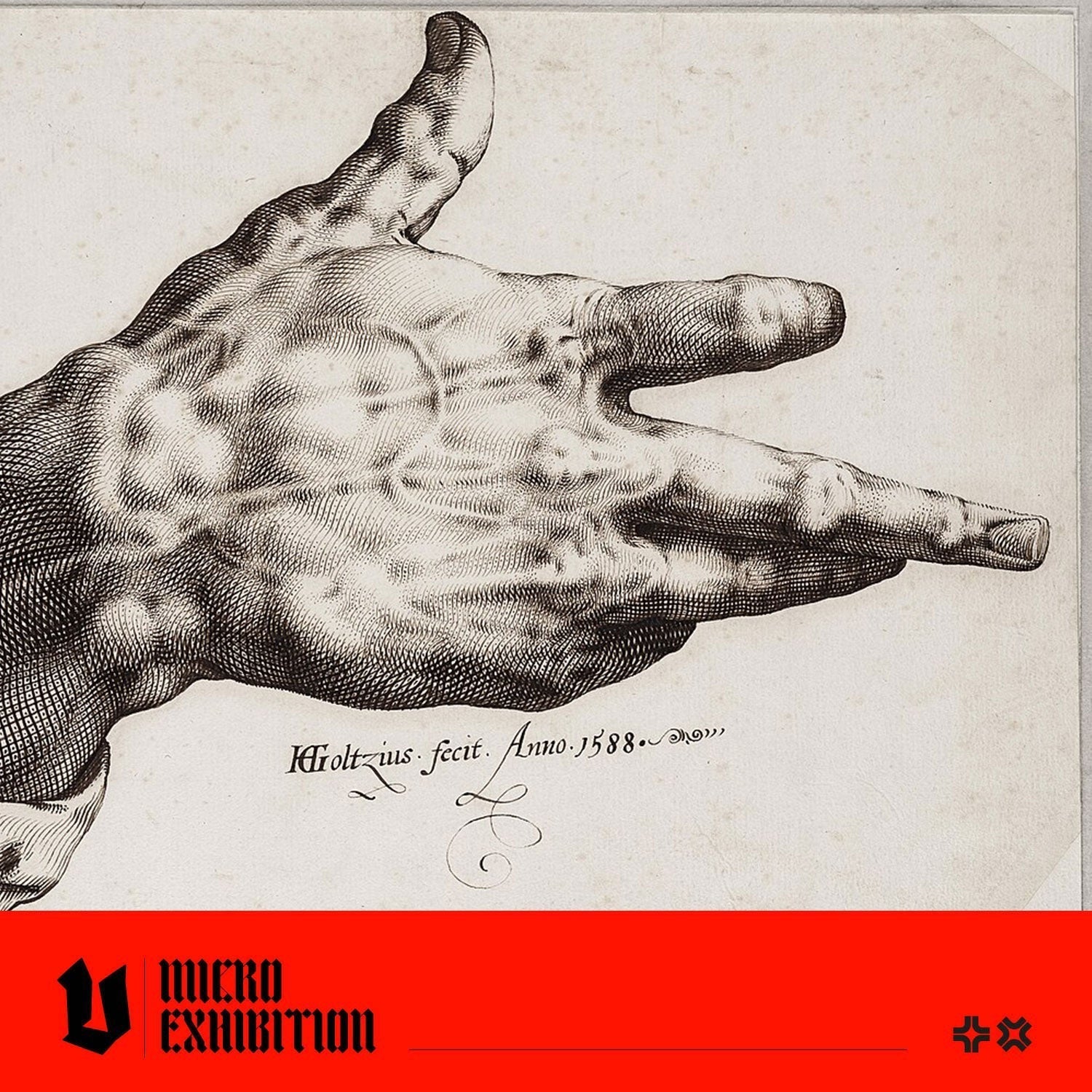
Goltzius’s right hand, by Hendrick Goltzius, 1588
Why Goltzius Still Matters in Printmaking
The enduring interest in Goltzius lies less in spectacle than in discipline. He recognised that engraving did not require additional tools or effects in order to evolve, but rather a deeper sensitivity to pressure, spacing and restraint. In his prints, the paper's white functions as light, and even the smallest adjustment in line weight alters the perception of form.

A dragon devouring the companions of Cadmus, by Hendrick Goltzius, 1588
For contemporary artists who work primarily with ink or line, that attention to control remains instructive. His engravings demonstrate that technical limitations can become expressive strength when approached with precision and patience. If you’d like to see more of his work, check out our Image Archives: Dragons and Mythical Creatures and Greek and Roman Mythology.