In the seventeenth century, paintings of birds often depicted them hanging from a hook in a kitchen still life, or perhaps a heap of dead birds arranged around a hunter’s bag. Jan Fyt was a leading animal and still-life painter of the era, and his paintings were executed beautifully: his birds’ feathers were colourful and lustrous, and their glazed eyes were rendered with precision, but the birds in those paintings were static subjects and lacked the narrative and personality they had in life. Artist Melchior d’Hondecoeter viewed birds in a completely different way.

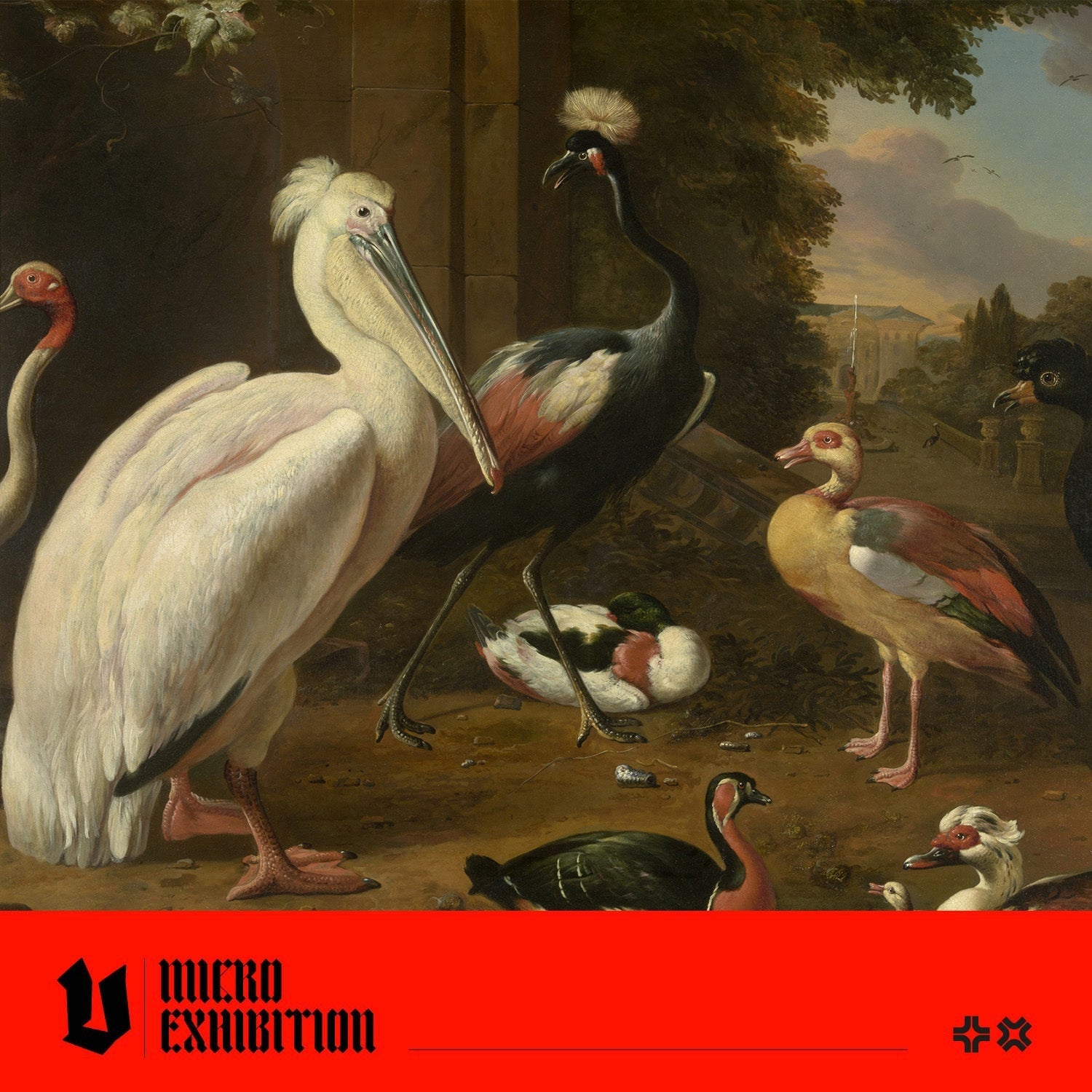
Waterfowl, Melchior de Hondecoeter
What made Melchior d’Hondecoeter’s Art Different?
Melchior d’Hondecoeter (c.1636–1695) came from a family steeped in painting; his grandfather and his father both worked with animals and landscapes, but he devoted his career to painting birds.
He lived in Amsterdam and kept birds in his garden specifically to study them, building a reputation that would eventually reach the court of Stadtholder William III, who commissioned him to paint the royal menagerie at Het Loo palace. But what made him famous was not technique, or scale, or the exotic species he populated his canvases with, though all of those played their part. It was the simple, radical decision to paint birds as living beings with passions, joys, fears and quarrels. He was, as one account put it, bold of touch and sure of eye, giving the motion of birds with a spirit and accuracy no one before him had quite managed. But across all of it runs the same conviction: that to paint a bird as a dead thing, however beautifully, was to miss the point entirely.

Two Peacocks Threatening a Hen with Chicks, Known as ‘The Threatened Hen’ (1681), Melchior de Hondecoeter
The dead-game tradition treated birds as objects, but D’Hondecoeter treated them as subjects. His canvases are bursting with life, such as a hen gathering her chicks from a predator with a focused anxiety, a crane turning its head toward something just outside the frame. There is always the sense that you have arrived mid-scene, that a social life of considerable complexity was already underway before you looked, and will continue after you look away.
One early critic captured this quality memorably saying: d’Hondecoeter displays the maternity of the hen with as much tenderness and feeling as Raphael the maternity of Madonnas, regarding his ability to find genuine emotional weight in a subject his contemporaries were content to leave beautiful and inert.

Birds on a Balustrade (c.1680 - c. 1690), Melchior de Hondecoeter
Amsterdam in the late seventeenth century sat at the centre of a global trading network, and with the ships came birds that most Europeans had never encountered, these were painted alongside farmyard geese and strutting peacocks as though it were the most natural thing in the world. What is striking is that the rarity of a bird never changed how he approached it. Every creature in a d’Hondecoeter canvas seems to have its own personality.
The Dramatic Narrative of ‘The Crow Exposed’
The personality of birds is expressed vividly in The Crow Exposed (c.1680, Museum of Fine Arts, Houston) or Stripped of Borrowed Feathers; the Raven-Jackdaw (The Heckscher Museum of Art, Huntington, NY, USA). The subject comes from Aesop’s oldest and most merciless version of the fable. A crow, ashamed of its perceived plainness, has decorated itself with feathers stolen from many different birds. When the birds discover the impostor in their midst, they descend on it together, with each species reclaiming its feathers. In some tellings of the story, the crow is stripped so completely that it is left with nothing at all, rejected afterwards by every flock it approaches.

The Crow Exposed, Melchior de Hondecoeter
D’Hondecoeter sets this scene at scale and populates it with the full cast of his avian world. Peacocks, cranes, and exotic species from across the Dutch trading empire crowd the composition alongside farmyard birds, each one rendered with his characteristic sharpness of observation. What makes the painting extraordinary is the quality of feeling in the room. The attacking birds are not chaotic; they are righteous. The crow at the centre is cornered, and the elaborate fiction of its borrowed identity unravels feather by feather in front of everyone. But look again at the crow. It didn't steal those feathers out of malice. It stole them because it didn't believe what it already was was enough. The tragedy of the painting isn't only the brutal exposure; it’s that the crow was wrong about itself from the start. Crows are among the most intelligent, adaptable and remarkable birds alive, and it didn’t need to cover itself in borrowed feathers; it's own feathers were already beautiful.

The Menagerie (c. 1690), Melchior d'Hondecoeter
In lesser hands, this would be a moral lesson given visual form and hung on the wall to satisfy the period’s requirement that paintings carry improving moral messages. What d’Hondecoeter paints is something far more uncomfortable. He understood, perhaps better than any painter of his age, that birds have social lives, full of hierarchies, alliances, vanities, and grievances, and he used Aesop’s framework to paint a scene of collective punishment that feels entirely real. The fable is almost incidental; this scene depicts a community enforcing its boundaries, with a ferocity that has nothing allegorical about it.

Peacocks, male and female (1681), Melchior d'Hondecoeter
We may consider animal painting as a minor tributary of art history, something decorative, a background element. D’Hondecoeter invites us to look carefully at other creatures, to resist the habit of treating them as a background or supporting characters, and to find in their behaviour something that reflects our own.