Martin Schongauer, an engraver and painter from Colmar, was an incredibly talented and accomplished artist. One of his fans was none other than Albrecht Dürer, who collected his work, and Giorgio Vasari, an Italian Renaissance painter, architect, art historian, and biographer, also reported that Michelangelo copied one of his engravings. Today we'll learn more about his work, and how his technical innovations helped create his legacy. Let's go!

Griffin, by Martin Schongauer
Early Life and Artistic Training
Born around 1450, Schongauer grew up in his father’s goldsmith workshop. That specific training completely shaped his approach to metal. While earlier engravers treated copper plates like flat woodcuts, producing stiff, rigid lines, Schongauer brought a jeweller's sensitivity to the medium. He had an instinct for how light hit a surface and how the physical pressure of his hand could vary a line.
Though he briefly attended the University of Leipzig, his artistic style was deeply rooted in Early Netherlandish painting, drawing heavily on the expressive figures and sharp, angular drapery of Rogier van der Weyden’s circle.

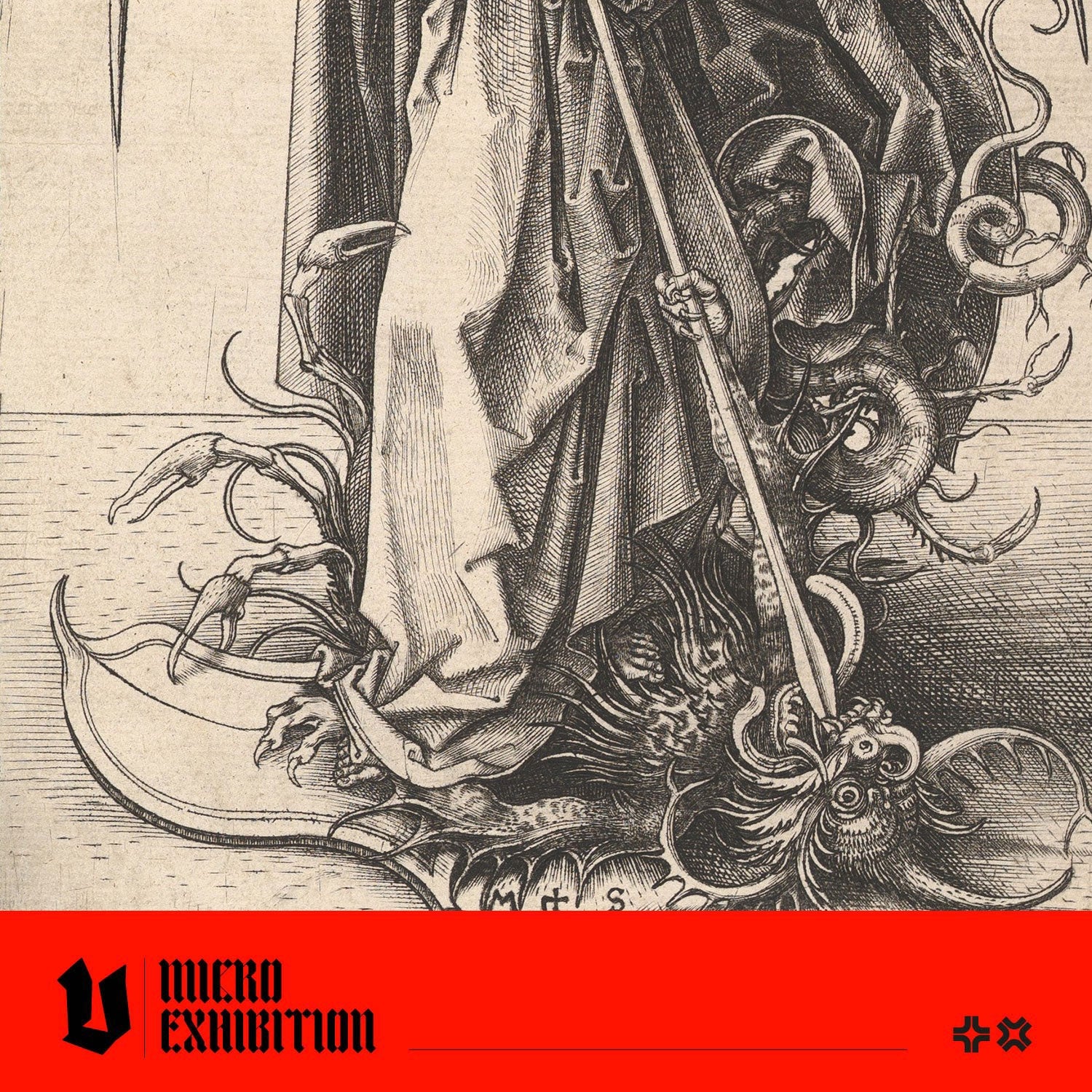
St Michael, by Martin Schongauer
Innovations in Printing Techniques
Only 116 engravings survive from Schongauer's hand, but they completely revolutionised printmaking technology. He was the first north of the Alps to master cross-hatching to create deep, convincing shadows. He also pioneered curving parallel lines, likely by rotating the copper plate against a steady steel cutting tool, allowing him to model human form with real volume.
Because of his background in metallurgy, he cut deeper grooves into his plates. This technical upgrade prevented the copper from wearing down quickly, allowing hundreds of crisp prints to be distributed across Europe. Suddenly, an artist could accurately render diverse textures on paper: the sheen of armour, the soft weight of fur, or the rough bark of a tree.

Ornament with Owl Mocked by Day Birds, by Martin Schongauer
Legacy and the Dürer Connection
His absolute masterpiece, The Temptation of Saint Anthony, became a blueprint for European art. Its writhing, imaginative hybrid monsters set the standard for northern fantasy, directly inspiring painters like Hieronymus Bosch.
Schongauer died in 1491 in Breisach while working on a massive cathedral fresco. The very next year, a young Albrecht Dürer travelled to Colmar specifically to meet his idol, only to find Schongauer had just passed away. Dürer stayed to study the remaining workshop drawings, courtesy of Martin’s surviving brothers, from whom he acquired several of the master's studio drawings, which he treasured and collected for the rest of his life as he continued the lineage of master printmaking.

The Temptation of Saint Anthony, by Martin Schongauer, probably created c. 1470–1475