The History and Origins of Collage Art
Braque and Picasso are usually credited with inventing collage in 1912. The reality is more complicated, and more interesting. Today we're taking a closer look at the long, surprising history of collage art. Let's go!

Hannah Höch, Cut with the Dada Kitchen Knife through the Last Weimar Beer-Belly Cultural Epoch in Germany, 1919, collage of pasted papers, 90x144 cm, Staatliche Museum, Berlin
What Is Collage?
Even the definition is contested. The National Galleries of Scotland describes collage as "an image constructed from found materials, such as photographs, paper or fabric, glued to a surface, sometimes with additional painted or drawn elements", and acknowledges that "collage techniques in various forms have existed for centuries," even if the term itself was only adopted in the early twentieth century.
The Guggenheim goes further, arguing that what Braque and Picasso introduced was something genuinely new: a collision between found material and the picture surface that gave "each medium some of the characteristics of the other", both serious and tongue-in-cheek, methodically reexamining what painting and sculpture could be.
As Guggenheim curator Diane Waldman put it, collage "has brought the incongruous into meaningful congress with the ordinary." And yet the Met points out that "sixty years before the embrace of collage techniques by the avant-garde artists of the early twentieth century, aristocratic Victorian women were already experimenting with photocollage." So the question of who invented collage depends entirely on how you define it.
Central to that debate is the question of intention. Sticking paper down is just a technique; what matters is why you chose that particular fragment, and what happens when you place it somewhere new. When Picasso chose wallpaper printed with a floral pattern for one work and a Moorish geometric for another, he was making deliberate statements about gender and culture. Artists like Heartfield, Höch and Rodchenko pushed this further, using collage to make urgent political arguments. What you cut, and where you put it, is the work, and what separates collage from scrapbooking.

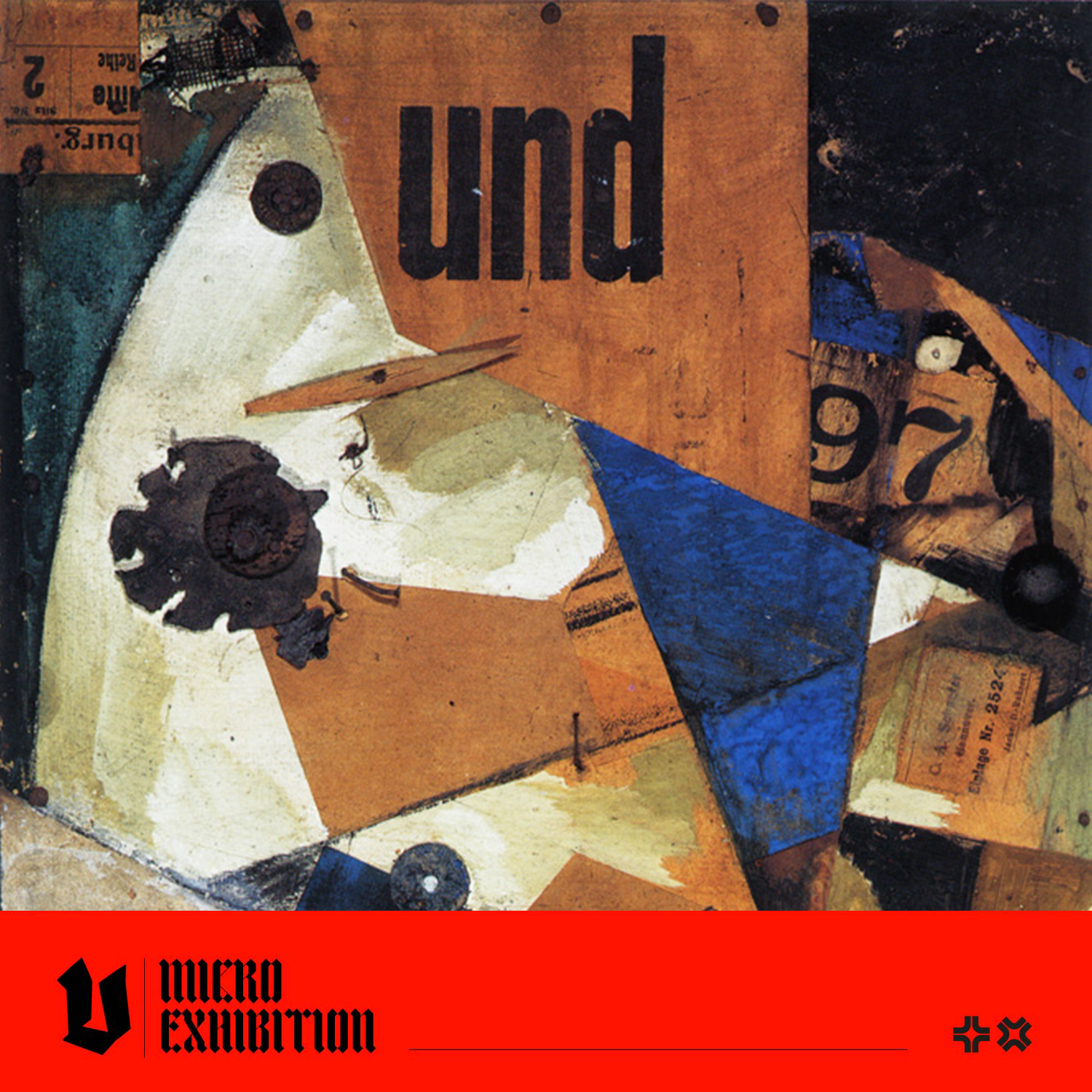
Kurt Schwitters, Das Undbild, 1919, Staatsgalerie Stuttgart
Early Collage: Heian Japan
Paper collage is among the earliest sustained examples we can point to, appearing in 10th-century Japan. Some of the finest surviving examples are in the Sanjurokunin Kashu, the Anthology of the Thirty-Six Poets, handmade in the early 12th century by ladies of the imperial court for the birthday of Emperor Toba, and held at Nishi Hongan-ji in Kyoto.
Its pages are composed of dyed, flecked, gold-scattered and block-printed papers, joined by hand. Each design was personal, alluding to some aspect of the poet whose work it accompanied. Whether it counts as collage depends on your definition. By technique, certainly. By intent, the materials were chosen with care and meaning, but to make the page more beautiful. It doesn't have the collision with the picture surface, or the incongruity, that is central to Braque and Picasso's collage work, which is not a negative observation, it's just a different kind of collage.
 Two pages of the collected poems of Minamoto-no-SHIGEYUKI(?-ACE 1000). 20cm height, 32cm wide. Silver, Gold, Colour, and ink on ornamented paper. One of the Collection of the works of thirty six master poets in the NISHI-HONGANJI, Kyoto. Most luxurious illuminated manuscript books survived from ancient Japan.
Mary Delany and the Botanical Collage
Among the earliest people in Europe to treat cut paper as a serious artistic practice was Mary Delany, and she started at the age of seventy-two. Around 1771 she began cutting coloured tissue paper freehand and layering it onto black backgrounds, sometimes using 200 separate pieces for a single flower. She made 985 of them before failing eyesight stopped her in 1784. Sir Joseph Banks, the botanist and naturalist, later became President of the Royal Society, praised their accuracy, saying they were the only imitations of nature from which one could describe any plant botanically "without the least fear of committing an error." The whole collection is now in the British Museum.

Rubus odoratus L. - Paper collage botanical, Mary Delany, 1772–82
Victorian Photocollage: Who Really Got There First
When Raoul Hausmann and Hannah Höch saw a military lithograph on the Baltic island of Usedom in 1918, a soldier's portrait pasted over a printed uniform, they immediately recognised its potential. "One could make paintings entirely composed of cut-out photographs," Hausmann wrote. What they didn't know was that aristocratic Victorian women had been doing exactly that for sixty years. As the Met notes, they were already cutting up cartes de visite (small photographic portrait cards that Victorians traded and collected like social currency) and combining them with watercolours to create fantastical compositions. Sitters appear with their heads on birds' bodies, faces set into painted teacups, family members floating at wild changes of scale. The Met describes these images as revealing "the educated minds as well as the accomplished hands of their makers."
These albums were dismissed as a form of parlour amusement for a century. The Met now describes them as anticipating "the embrace of collage techniques by the avant-garde artists of the early twentieth century" by sixty years.

Marie-Blanche-Hennelle Fournier (French, 1831–1906), Untitled page from the Madame B Album, 1870s
Braque and Picasso: When Collage Became Art
What Braque and Picasso did in 1912 was genuinely new, not the technique, but the intent. Picasso's Still Life with Chair Caning, now in the Musée Picasso in Paris, pasted printed oilcloth onto canvas; Braque's Fruit Dish and Glass, now at the Metropolitan Museum of Art, introduced strips of faux bois wallpaper. The Guggenheim describes the result as a collision between found material and the picture plane that gave "each medium some of the characteristics of the other." A painting had been a window you looked through; now it was an object.

Still Life with Caned Chair, Pablo Picasso, 1912
The Consistent Thread: Contemporary Collage
By the post-war period, collage had become the default language of visual culture. Paolozzi and Hamilton used American advertising to launch Pop Art. Punk used newspaper headlines and the photocopier to create iconic designs for merch, flyers and zines. Today, anyone can use digital techniques to create their own collages, with the only limit being their imagination.
Feeling Inspired?
Check out our Intro to Digital Collage Tutorial, where Kale will teach you how to make your own digital collage. The image sample pack and tutorial are completely free, so give it a try today!

Fruit dish and Glass, 1912, papier collé and charcoal on paper by Georges Braque