Sea Monsters in Art: A History from Ancient Greece to the Romantic Era
Sea monsters have been a fixture of human art for thousands of years, from ancient Greek pottery to Renaissance sea charts to Edo period woodblock prints. Today we're taking a closer look at the different ways mysterious and fantastical sea creatures have inspired artists throughout the world, and through the centuries. Let's go!

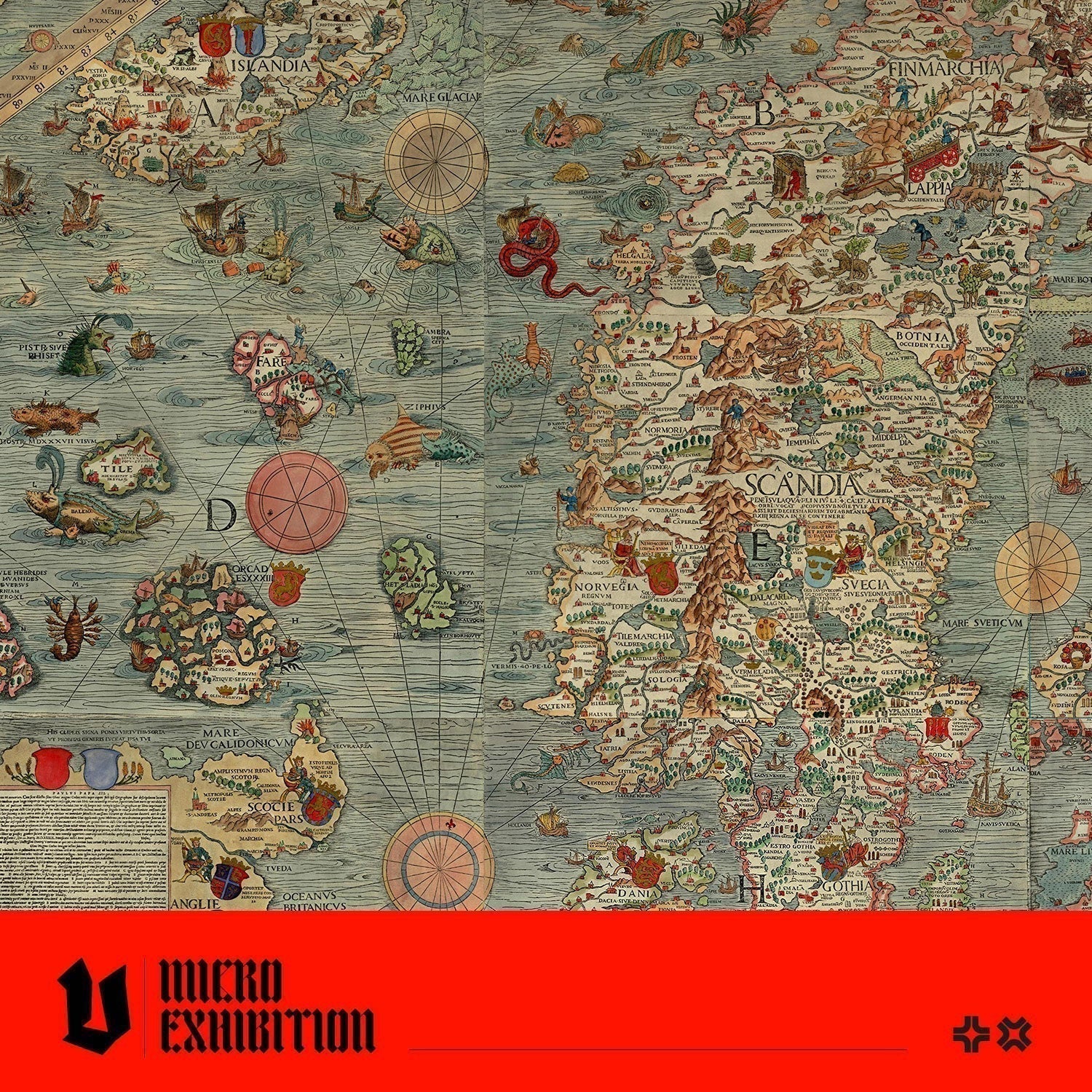
Detail from Carta marina et descriptio septemtrionalium terrarum ac mirabilium rerum in eis contentarum diligentissime elaborata anno dni, by Olaus Magnus, 1539
The First Sea Monsters in Art: Ancient Greece
Among the earliest surviving sea monster imagery are ancient Greek vases. The ketos — a formidable leonine-headed beast with scales, fins and prominent fangs — appears on Cretan pottery as early as 650 BCE. One of the finest surviving examples is held at the Metropolitan Museum of Art, where it is described as "among the earliest extant representations of a Greek ketos." According to the Met, the ketos iconography proved so enduring that after Alexander the Great's conquests it travelled east, appearing in art from Afghanistan to India — and has even been suggested as a partial inspiration for the Chinese dragon.
Scylla, the many-headed monster who snatched sailors from passing ships in the straits of Messina, also features widely in Greek pottery. The Met holds a late Apulian askos (a small, low-spouted vessel used for pouring oil or wine) with her snake-like body curling to create the handle, though her head has been lost.

Terracotta vase in the form of a ketos (sea monster), Greek, Cretan or South Italian, 2nd half of the 7th century BCE
Sea Monsters in Medieval and Renaissance Cartography
One of the most fascinating contexts for sea monster imagery is medieval and Renaissance cartography. Mapmakers, faced with vast stretches of unexplored ocean, filled the blank space with creatures, real and imagined. The most famous example is the Carta Marina (1539), a Scandinavian sea chart created by Olaus Magnus (a Swedish Catholic priest and scholar in exile), crowded with fantastical sea creatures battling each other and harassing ships, mysteriously shaped islands, and of course, a ship stuck in a giant whirlpool.
Sailors' garbled reports of real animals (giant squid, orcas, walruses) were redrawn by artists who had never seen them, and with each retelling the creatures grew stranger. Though embedded in popular culture, the phrase "here be dragons" is rarely found on actual historical maps; the only confirmed example is on the Hunt-Lenox Globe (c.1510), now held at the New York Public Library, where it appears along the eastern coast of Asia.
 Detail from Carta marina et descriptio septemtrionalium terrarum ac mirabilium rerum in eis contentarum diligentissime elaborata anno dni, by Olaus Magnus, 1539

Carta marina et descriptio septemtrionalium terrarum ac mirabilium rerum in eis contentarum diligentissime elaborata anno dni, by Olaus Magnus, 1539
Sea Monsters in Japanese Art: The Yōkai Tradition
In Japan, the sea monster took on a very different visual language. Where European mapmakers drew warnings, Edo period woodblock artists wove sea creatures into the yōkai tradition, a world of supernatural beings from Japanese folklore where the ocean's inhabitants were strange and unpredictable rather than purely threatening. They were dangerous, but inhabited a broad world of magical folklore.
Utagawa Kuniyoshi's print of the Umibozu, a vast, smooth-headed sea creature said to rise from the deep and capsize ships, is one of the finest examples. It comes from the series Fifty-three Parallels for the Tōkaidō Road (1843–1845), a celebrated collaboration between three of the great ukiyo-e artists of the day; Kuniyoshi produced thirty-one prints, Utagawa Hiroshige nineteen, and Utagawa Kunisada the remaining eight, adding up to rather more than the fifty-three the title implies. Each print pairs a story from Japanese folklore with one of the post-stations along the Tōkaidō road.
In Kuniyoshi's print, the sailor Tokuzo goes to sea on the last day of the year, despite it being considered particularly inauspicious. A violent storm breaks out and the Umibozu rises before his ship, threatening to capsize it. The monster asks Tokuzo a riddle: to name the most horrible things he knows. Tokuzo replies simply "my profession", and the monster, satisfied, lets him go. It is a very different kind of sea monster story to anything in European tradition: less about physical conquest, more about winning through wit.
 Kuniyoshi Utagawa, 43. Kuwana. The Sailor Tokuzo and the Sea Monster Umibozu, Fifty-three Parallels for the Tokaido Road, 1843 - 1845
Sea Monster Art in the Romantic Era
By the 18th and 19th centuries, European artists returned to sea monsters through the concept of the Sublime, an aesthetic idea first articulated by philosopher Edmund Burke, suggesting that art could harness overwhelming terror and awe to produce an experience beyond ordinary beauty. Painters and illustrators working in the Gothic tradition depicted serpents and leviathans as expressions of nature at its most overpowering. Alfred Tennyson's poem "The Kraken" (1830) and the illustrated editions that followed fed directly into the Victorian fascination with sea serpent sightings, real and imagined.

Why Sea Monsters Continue to Inspire Artists

Feeling Inspired?
Our image archive Sea Life and Monsters of the Deep is packed with magnificent historical images of sea creatures, restored and curated by our team, and available as high-resolution 300 DPI downloads. Get your copy today!