Veridicus Christianus: Are Emblem Books the 17th Century version of an Infographic?
In 1601, a Jesuit priest in Antwerp published a book of 100 allegorical engravings designed to communicate complex ideas. It was part illustrated guide, part work of art, and it remains one of the most visually inventive books of the entire Baroque era. Today we're taking a closer look at Jan David's Veridicus Christianus and the extraordinary images at its heart. Let's go!

Who Was Jan David?
Jan David was born around 1545 and died in 1613. He was a Flemish priest and member of the Society of Jesus, a group better known as the Jesuits, a Catholic religious order founded in 1540 whose members were known as much for their scholarship and love of art as for their faith. David served as rector of the Jesuit colleges at Courtrai and Ghent, and was a prolific writer who produced a series of illustrated books in collaboration with some of the finest engravers in Antwerp. Veridicus Christianus, or "The True Christian," was his most celebrated work, and the one that established him as a pioneer of the emblem book tradition.
What Is an Emblem Book?
Emblem books were one of the great publishing phenomena of the 16th and 17th centuries. Each "emblem" combined three elements: a motto or title, a symbolic image, and explanatory verses or prose. They were designed to be read and viewed simultaneously, with image and text working together to convey a message. Think of them as the illustrated infographics of their time; visually compelling, carefully designed, and intended to lodge an idea firmly in the reader's mind.

Veridicus Christianus is widely regarded as the first Jesuit emblem book, and one of the most sophisticated examples of the form. David understood that images could reach audiences that text alone could not, and this was especially true in an era of widespread illiteracy. The book's images served different audiences; people could discover through looking what they could not otherwise understand, while those who could read would find in them a visual reinforcement of what they had already learned through text. It was, in essence, a communication system designed to work on multiple levels simultaneously.
Discovering Veridicus Christianus
Veridicus Christianus began life as a hundred questions and answers written by Jan David. An unillustrated Dutch version had been printed in Brussels in 1597, but David had a grander vision. He conceived the idea of accompanying each chapter with an allegorical engraving, a commission assigned to the studio of Philips Galle and probably executed by Philips' son Theodoor.

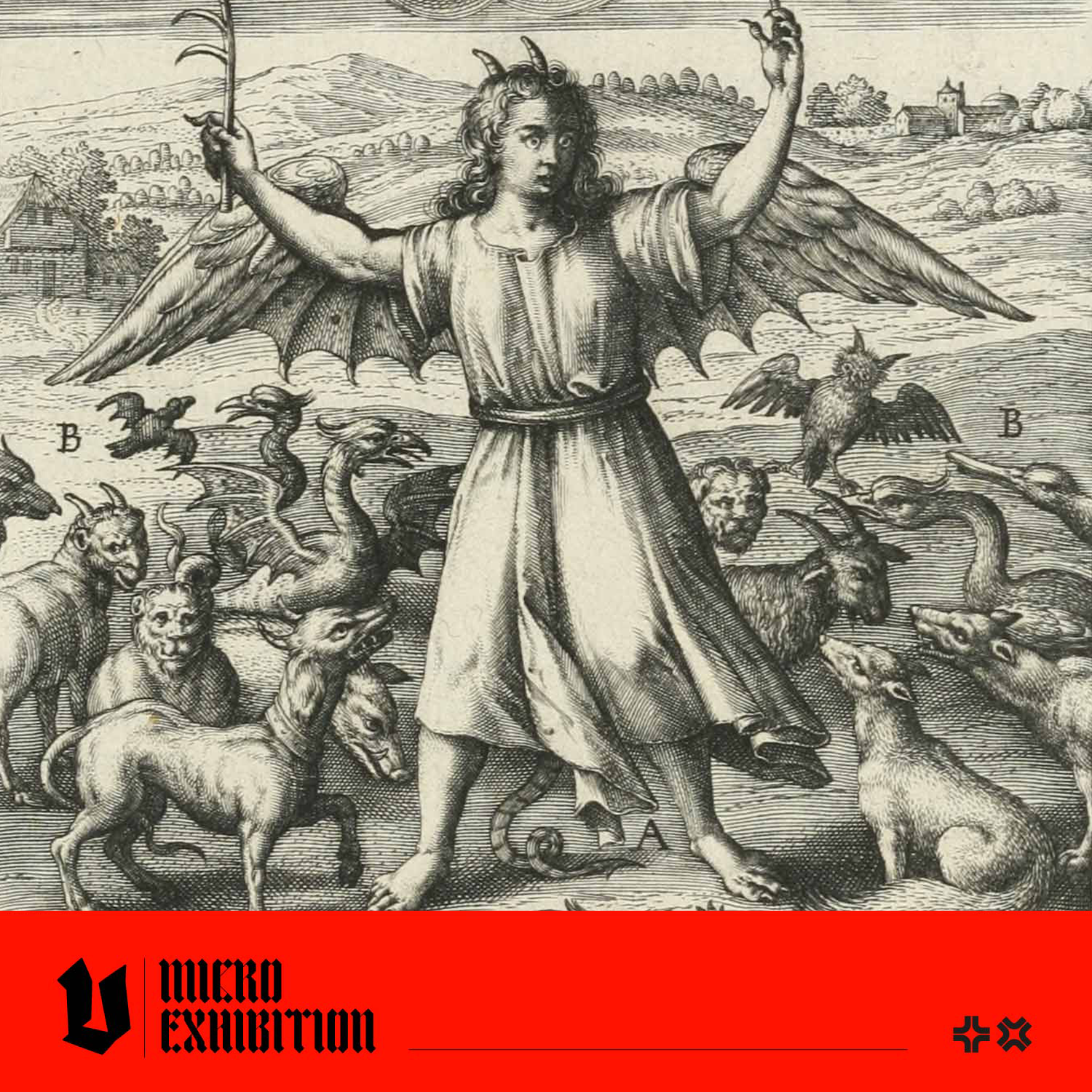
The result was a book of one hundred emblems, each built from four interlocking components: a titulus (title or motto) inscribed above the image; the pictura (the allegorical engraving itself), overlaid with Roman capital letters keyed to the explanatory text; epigrammatic couplets in Latin, Dutch, and French; and a prose commentary that forms the bulk of each chapter. Each emblem opens a chapter in which David develops the theme illustrated in the image — life, death, human nature, and the choices that define a person.
The book was printed at the famous Plantin-Moretus workshop in Antwerp, the most prestigious printing house in the Spanish Netherlands, by publisher Jan Moretus — a lavish production by any standard, and a landmark of Baroque book design.

Theodoor Galle and the Engravings
The visual heart of Veridicus Christianus is its 100 copper-plate engravings, and their quality is remarkable. The images are dense, allegorical, and richly detailed; crowded with symbolic figures, architectural elements, angels, demons, skulls, and the full visual vocabulary of 17th-century allegorical art.
One of the most striking examples depicts a skeleton climbing a ladder toward the open windows of a shed, which, on closer inspection, resembles a human head: its thatched roof the hair, its upper windows the eyes, its open door the nose and mouth. The image illustrates David's text directly: "Death enters through the windows of the eyes." It is at once a visual pun, a moral lesson, and an image that lodges itself firmly in the mind.

The engraving Orbita Probitatis sets a similarly playful tone. It depicts a group of figures gathered around a scene, each one perched before an easel, painting their own version of what they see, it's a visual metaphor for the idea that every viewer brings something different to an image.

Theodoor Galle came from one of Antwerp's most distinguished engraving dynasties. His father Philips Galle had run one of the city's leading print workshops, and Theodoor went on to produce illustrations for a series of Jan David's books, establishing a remarkable creative partnership between writer and image-maker. Scholars have noted that the engravings are not straightforward emblem variants but rather represent a completely different system of text-and-image synthesis, where image and prose are so tightly interwoven that neither can be fully understood without the other.

A Hidden Game and the Book’s legacy
One of the curiosities of Veridicus Christianus is the Orbita Probitatis, or "Wheel of Probity", which is a supplementary section at the end of the book featuring an ingenious interactive mechanism. Think of it as a built-in board game: a paper wheel, fixed to the page by a string, sits behind a sheet pierced with four small windows. The reader spins the wheel, and numbers appear in the windows. They pick a number, look it up in an index of one hundred short quotes drawn from classical authors, read their chosen quote, and are then directed to find the corresponding image among the book's hundred engravings to contemplate.
For a book published in 1601, it is a remarkably modern idea, a randomised, interactive reading experience that prefigures the logic of hyperlinks and choose-your-own-adventure narratives by several centuries. As a piece of graphic design, it was centuries ahead of its time: a system designed to inform, educate, and stay with you long after the book is closed.