Giovanni Battista Piranesi created some of the most widely circulated images of Rome ever made, drawn as much from his imagination as from the ruins in front of him. Today we're taking a closer look at the multidisciplinary artist whose prints shaped how the world saw Rome. Let's go!
Who Was Giovanni Battista Piranesi?
Giovanni Battista Piranesi was born on 4 October 1720 in Mogliano Veneto, then part of the Republic of Venice. His father was a stonemason; his brother Andrea taught him Latin and classical history; and his uncle Matteo Lucchesi, a prominent architect who specialised in restoring historic buildings, took him on as an apprentice. In 1740, at the age of twenty, he arrived in Rome, the city that would define his life's work.

Architectural Fragments from Trofei di Ottaviano Augusto (Trophies of Octavian Augustus), Giovanni Battista Piranesi, 1753
He trained as an architect but built only one building: the church of Santa Maria del Priorato in Rome, where he was also buried. Rather than pursue building commissions, he reinvented himself as an etcher and designer, though he always signed his work architetto, the Italian word for architect. His teacher, Giuseppe Vasi, may have seen this coming. When Piranesi was still a student, Vasi told him: "You are too much of a painter, my friend, to be an engraver."
The Smithsonian's Cooper Hewitt Design Museum describes him as a designer in the fullest sense, noting his wide-ranging output across architecture, interiors, furniture and decorative arts. In many ways, he was the graphic designer of his age. The Escher Museum in The Hague says he was someone "not hindered by the straitjacket of reality, but could give voice to his imagination and personal opinions." Perhaps his own motto summed up his approach the best: col sporcar si trova, or "by messing about, one discovers."
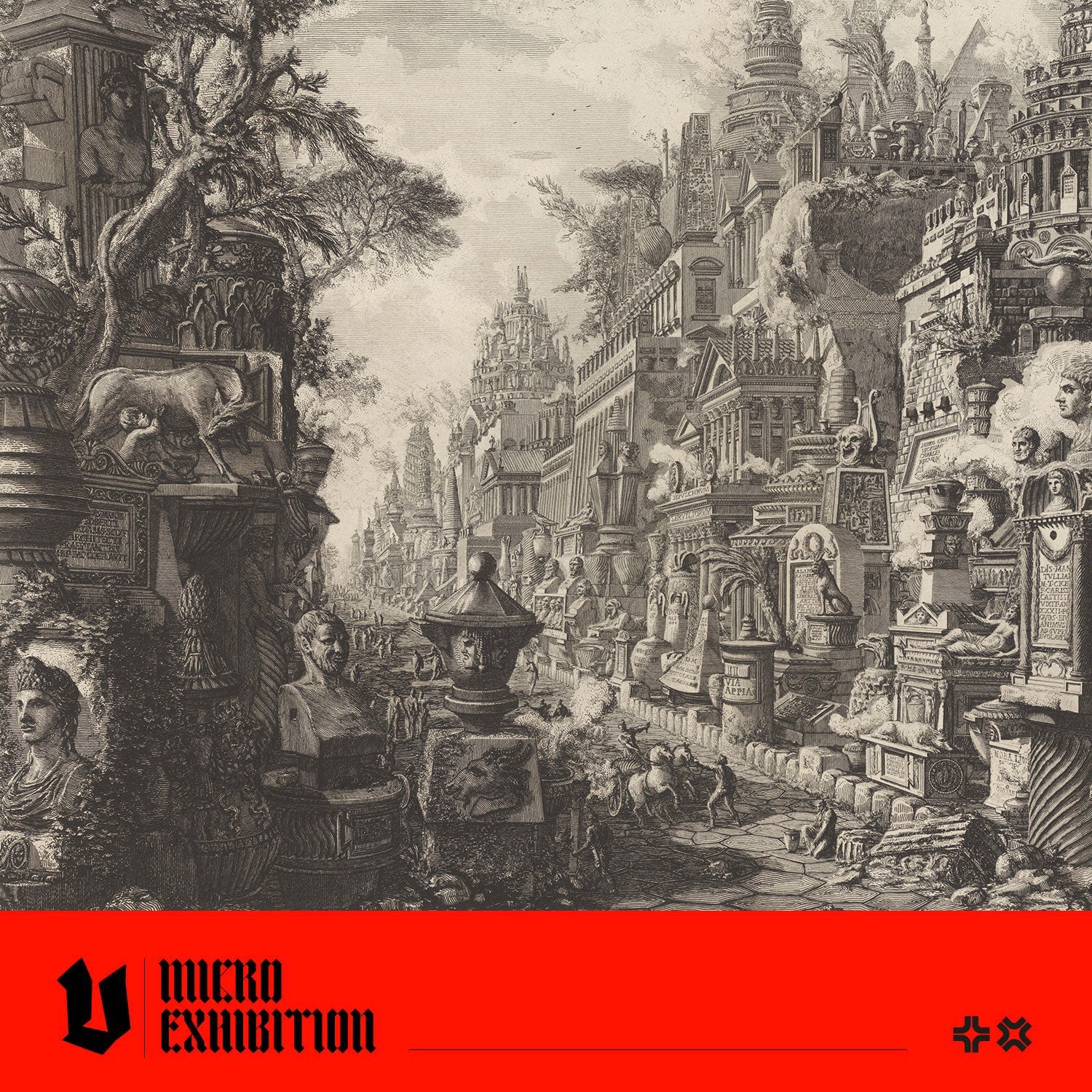
 The Frontispiece with a Fantasy Representation of the Via Appia Antica, Giovanni Battista Piranesi, 1756–1757
The Vedute di Roma: Piranesi's Views of Rome
From 1748, Piranesi produced the body of work that would establish his fame: the Vedute di Roma (Views of Rome), a series of 135 etchings depicting the monuments, ruins and streets of Rome. He worked on the series for thirty years, until his death in 1778.
He faithfully imitated the actual remains of Rome's monuments, while his imagination added drama and narrative to the buildings. He introduced groups of vases, altars and tombs that were absent in reality, manipulated scale, and used a bold distribution of light and shadow to create a striking effect. As the Bowdoin College Museum of Art puts it, the result is prints that blur the line between reality and fiction, romanticising Roman ruins in order to emphasise their grandeur. Some of the prints are also notable for their human figures, distorted and off-balance, marked by poverty and struggle. According to scholar Jeanne Morgan Zarucchi, these figures may reflect a well-recognised literary tradition that conceived of the ruins of Rome as a metaphor for human mortality and social decay.

View of the Pyramidal Tomb of Caius Cestius, from Views of Rome, Giovanni Battista, 1756
The prints sold widely, bound as volumes or as individual sheets, and were particularly popular among English gentry on the Grand Tour, who bought them as souvenirs from his workshop on the Via del Corso. They continued to be printed well into the 19th century and were equally popular among American tourists. By the mid-19th century, Piranesi's etchings appeared in many public and private collections in the United States, including a complete set gifted to the Boston Public Library in 1869. His idealised vision of Rome became the version many people carried in their minds.
In his Italian Journey (1786-1788), Goethe noted that Rome's monuments had failed to live up to the image Piranesi's prints had given him. Piranesi himself described the ruins as filling his spirit "with images that accurate drawings, even such as those of the immortal Palladio, could never have succeeded in conveying", a bold claim, given that Andrea Palladio was the Renaissance architect. His designs influenced grand buildings in England and America, including the White House.
M.C. Escher was among his most devoted admirers; when he moved to Switzerland in 1935, he hung a number of Piranesi's prints in his studio. Piranesi's influence is evident in Escher's work: his 1934 woodcut Nocturnal Rome: Castel Sant'Angelo depicts the same monument Piranesi had etched almost two centuries earlier.
M.C. Escher was among his most devoted admirers; when he moved to Switzerland in 1935, he hung a number of Piranesi's prints in his studio. Piranesi's influence is evident in Escher's work: his 1934 woodcut Nocturnal Rome: Castel Sant'Angelo depicts the same monument Piranesi had etched almost two centuries earlier.

View of the Mausoleum of the Emperor Hadrian (now called Castel S. Angelo) from the rear, from Vedute di Roma (Roman Views), Giovanni Battista, 1756
Piranesi's Imaginary Prisons: The Carceri d'Invenzione
In 1749, Piranesi began work on the Carceri d'Invenzione, or Imaginary Prisons, a series of 16 etchings depicting enormous subterranean vaults, labyrinthine staircases, bridges, gates, galleries and ominous machinery. Many of the figures within them are tiny, dwarfed by the scale of the surrounding architecture.
The first edition of 14 plates was published in 1750. He returned to the series in 1761, reworking every plate, dramatically heightening the contrast between light and dark, adding two new compositions, and introducing deliberate impossible geometries into several of the designs. The second edition was far more dramatic than the first, darker, more menacing, and more spatially disorienting, and went on to enjoy iconic status in printmaking.

First plate in the second edition of Le Carceri d'Invenzione, Giovanni Battista Piranesi, 1761
The Carceri have been described as "colossal, vertiginous spaces that seem to never end, labyrinths filled with an infinite number of stairs, ladders, bridges, gates and galleries, none of which seem to lead anywhere." (Escher Museum, The Hague) Piranesi exaggerates perspective and renders his spaces with dramatic lighting and a dark, menacing quality that characterises Piranesi's series. Without this series, we may not have M. C. Escher's Relativity.
Aldous Huxley wrote an essay accompanying a 1949 edition of the Carceri d'Invenzione, drawing a parallel between Piranesi's imaginary prisons and the architecture of real prisons: buildings designed to control, surveil and surveil and dehumanise their inhabitants.
Aldous Huxley wrote an essay accompanying a 1949 edition of the Carceri d'Invenzione, drawing a parallel between Piranesi's imaginary prisons and the architecture of real prisons: buildings designed to control, surveil and surveil and dehumanise their inhabitants.

The Man on the Rack, 2nd plate in the second edition of Le Carceri d'Invenzione, Giovanni Battista Piranesi, 1761
Artists and Writers Inspired by Piranesi
Three centuries on, the list of creatives who have cited Piranesi as an influence is remarkable. Among the writers alone: Goethe, Coleridge, Thomas de Quincey, Lord Byron, John Keats, Balzac, Victor Hugo and Edgar Allan Poe. The vast, oppressive industrial cityscape of Fritz Lang's Metropolis (1927) recalls the scale and atmosphere of the Carceri. In architecture, Aldo Rossi and Daniel Libeskind have both cited Piranesi as a formative influence. In literature, Umberto Eco's labyrinthine medieval library in The Name of the Rose owes something to his imaginary spaces, and Susanna Clarke's 2020 novel Piranesi is named after him.

XI / The Arch with a Shell Ornament, 11th plate in the second edition of Le Carceri d'Invenzione, Giovanni Battista Piranesi, 1761
At Vault Editions, we continue to be inspired by creatives who worked in a world very different from our own, yet whose ideas, inspirations and creative outputs still resonate with contemporary audiences. This rich heritage of art history is a treasury to explore and celebrate, and we're excited to share this journey with you.
Feeling inspired? Explore Vault Editions' image archives, featuring hundreds of beautifully restored illustrations curated and restored by us, available as high-resolution 300 DPI downloads.

XIV / The Gothic Arch, 14th plate in the second edition of Le Carceri d'Invenzione, Giovanni Battista Piranesi, 1761