Decades before the birth of cinema, a Belgian physicist built a spinning disc that convinced the human eye it was watching motion. That device, invented in late 1832, was the phenakistoscope, and it remains one of the earliest true forerunners of animation and cinema. Today we're taking a closer look at how it worked and examining some beautiful examples. Let's go!

The Origins of the Phenakistoscope
The phenakistoscope was invented by Joseph Plateau, born in Brussels in 1801. His father Antoine was a talented flower painter who enrolled his son at the Academy of Design in Brussels — but Joseph took a different path, eventually becoming a physicist. He never entirely left art behind, though: when he built his first prototype, he hand-painted the original designs himself.

Plateau arrived at the idea through years of careful observation. As a student, he noticed something strange while watching two toothed wheels spin rapidly in opposite directions: at the right speed, the wheels appeared to stop moving altogether. He eventually connected this to an 1824 paper by British scientist Peter Mark Roget, which explained why a spinning wheel viewed through vertical slats could look distorted or motionless. Further inspired by related experiments from Michael Faraday, Plateau constructed a working model of the phenakistoscope in late 1832.

He wasn't alone, Austrian mathematician Simon von Stampfer, then based in Berlin, developed an almost identical device around the same time, arriving at the same solution independently, just weeks later, having also been inspired by Faraday's work. He called his version Stroboscopische Scheiben, or "stroboscopic discs."

How Did Phenakistoscopes Work?
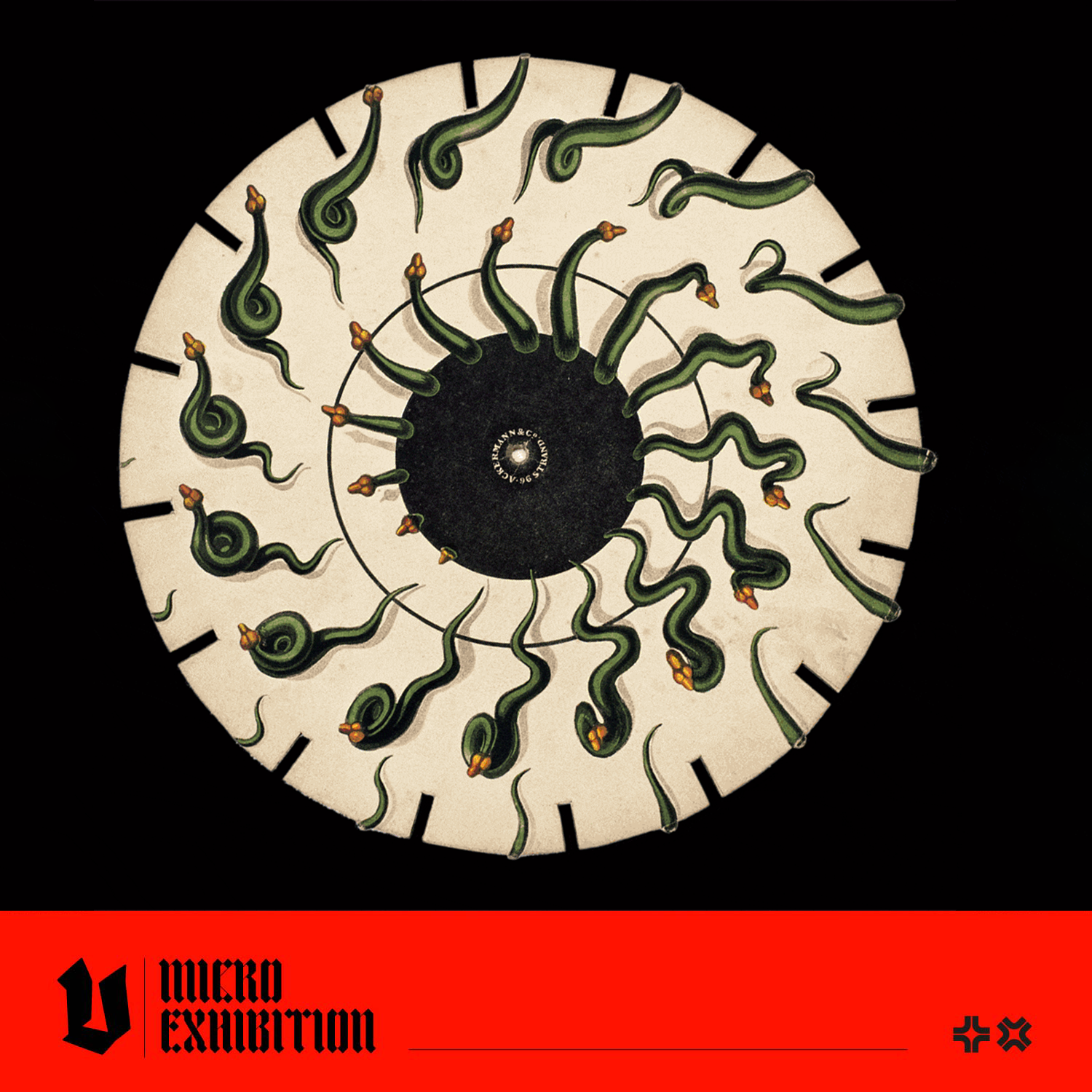
The mechanism was elegantly simple. A cardboard disc carried a sequence of hand-drawn images arranged in a circle, each showing a slightly different phase of a movement — a dancer mid-step, a horse mid-gallop, a juggler mid-toss. Around the disc's edge sat a row of narrow slots.

To use it, a viewer mounted the disc on a handle, held it up facing a mirror, spun it, and looked through the moving slots from the back at the reflected images. Each slot briefly exposed a single frame before snapping shut. Spun fast enough, the brain fused those flickering glimpses into what appeared to be one continuous, fluid motion, an effect now called flicker fusion. During the barely perceptible gaps between frames, each image was replaced by the next, and the eye filled in the rest.

It was a neat trick built on real physiology, and it caught on quickly. Within a year, phenakistoscope discs were being mass-produced and sold across Europe under a variety of easier-to-pronounce names, including Phantasmascope, Fantoscope, and Magic Wheel, and were printed with everything from dancing couples and acrobats to geometric patterns.

Unlike the zoetrope, which let several people watch at once by peering into a spinning drum, the phenakistoscope, in its classic form, was a solitary experience — one viewer, one disc, one mirror. The name itself tells you as much: it comes from the Greek phenakizein, meaning "to deceive," and ops, meaning "eye."

The Later Life of Joseph Plateau
In 1829, three years before he invented the phenakistoscope, Plateau stared directly at the midday sun for 25 seconds as part of an experiment to measure how long light impressions lasted on the retina. He went temporarily blind for several days, partially recovered, but the damage was done. He continued his scientific work for another four decades, aided by colleagues, his son Felix, and his son-in-law, dictating findings he could no longer observe directly. By 1843, he had completely lost his sight. He would never see a film; cinema itself wasn't born until the Lumière brothers held their first commercial screening in Paris in 1895, more than fifty years later. Modern doctors now believe the underlying cause was uveitis rather than the sun experiment alone, though Plateau himself always believed the two were connected.
The Legacy of the Phenakistoscope
The phenakistoscope was among the first devices to demonstrate that a sequence of static images, shown quickly enough, could simulate real movement. That single principle of image succession, fooling the eye into perceiving continuity, is the foundation on which everything that has followed has been built: the flip book, the zoetrope, Edison's kinetoscope, the Lumière brothers' cinematograph, and eventually the modern film reel and digital video. Original phenakistoscope discs survive in museum and archive collections and these beautiful and intricate objects continue to mesmerise viewers.