
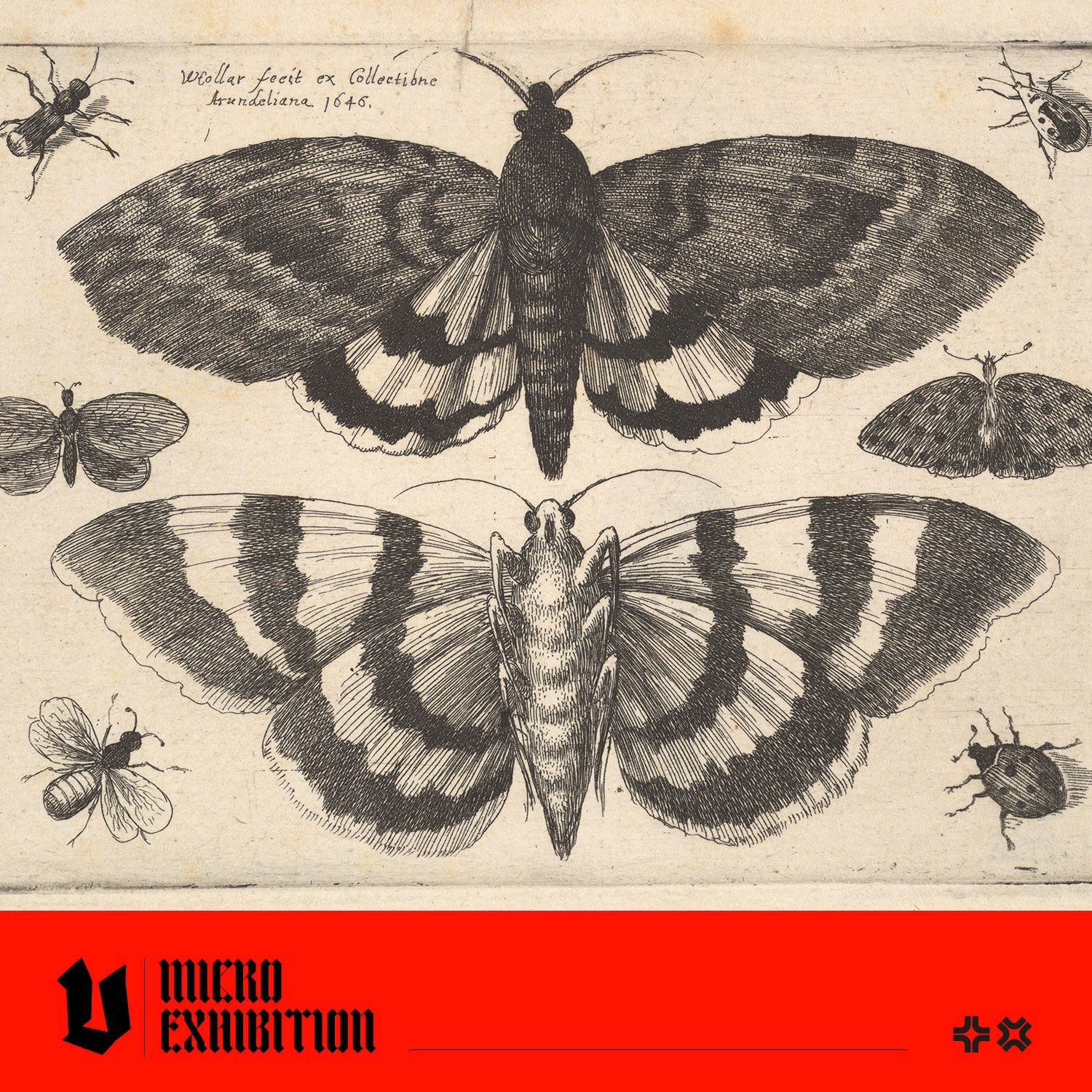
Wenceslaus Hollar was born in Prague in 1607, fled to London as a refugee, documented the city before and after the Great Fire of 1666, was appointed Royal Scenographer by Charles II and produced nearly 3,000 etchings in his lifetimeToday we’re taking a closer look at one of the 17th century's most prolific and important printmakers. Let’s go!

Two moths and six Insects, Wenceslaus Hollar, 1645
Who Was Wenceslaus Hollar?
Wenceslaus Hollar was born on 13 July 1607 in Prague, then the capital of Bohemia and part of the Holy Roman Empire. Emperor Rudolf II knighted his father, and the family was prosperous and well connected. That changed in 1620, when Prague was sacked after the Bohemian Revolt failed, and the family was ruined. Hollar defied his father’s wish that he study law and instead pursued a career as an artist. According to the London Museum, he appears to have had no formal artistic training.

Fireworks at Hemissem, Wenceslaus Hollar, ca. 1650
By 1627 he was in Frankfurt, working for the engraver and publisher Matthäus Merian — whose stepdaughter, the naturalist illustrator Maria Sibylla Merian (check out our article about her too!) would go on to become one of the most celebrated botanical artists of the century. Hollar moved to Strasbourg, then to Cologne, where, in 1633, he came to the attention of Thomas Howard, the Earl of Arundel, one of England's greatest art collectors. Arundel was in Cologne on a diplomatic mission and took Hollar into his service as a draughtsman, bringing him to London in 1637.
Wenceslaus Hollar’s Remarkable Etchings of London
Between 1636 and 1644, Hollar drew buildings and views across London, building up a detailed record of the city’s streets and skyline. His most celebrated early work, the Long View of London from Bankside, was a single-viewpoint panorama stretching from Whitehall to the Tower, printed in 1647 after he had already left for Antwerp. It remains one of the most important visual records of pre-fire London.
 Long View of London from Bankside, a panorama of London, by Wenceslaus Hollar, 1647
He also produced a celebrated series of etchings documenting women’s fashion across England and Europe, published in the late 1630s under the title The Severall Habits of English Women from the Nobilitie to the Country Woman. The 25 plates document dress from the highest court ladies to a country woman carrying a basket of vegetables, capturing fur muffs, wide-brimmed hats, face masks and elaborate ruffs. The London Museum notes that it was considered good manners to remove the mask when meeting friends.

Long View of London from Bankside, a panorama of London, by Wenceslaus Hollar, 1647 (Detail: Bankside and Strand to Baynard's Castle)
Wenceslaus Hollar and the Great Fire of London
In 1666, Charles II appointed Hollar Scenographus Regius, Royal Scenographer, and commissioned him to produce a large-scale map of London, a project he had seemingly been working towards for years. Then in September 1666, the Great Fire broke out in a bakery on Pudding Lane and burned for four days, destroying around 13,200 houses and 87 churches, including the old St Paul’s Cathedral, rendering the map obsolete overnight.
Rather than abandon the project entirely, Hollar produced a series of prints showing London before and after the fire, overlaying the two views so viewers could see exactly what had been lost. The contrast is striking: a dense medieval skyline of church spires and timber-framed rooftops on one side, a landscape of ash and rubble on the other, with only the brick chimney stacks still standing.


Prospects of London Before (above) and After the Great Fire (below), Wenceslaus Hollar, 1666
Because Hollar had been drawing London for decades before the fire, his earlier work became an irreplaceable record of a city that no longer existed.
Wenceslaus Hollar’s Legacy of Nearly 3,000 Plates
Hollar continued to work prolifically until his death. In 1668, Charles II sent him to Tangier to document the town and its fortifications. He returned to London and continued etching, producing illustrations for books and maps until he died on 25 March 1677 in Westminster. He was buried at St Margaret’s Church. Despite a lifetime of remarkable output, nearly 3,000 plates covering cities, landscapes, portraits, natural history, fashion and costume across Europe, he died in poverty.
His work survives in the collections of the London Museum, the British Museum, the National Portrait Gallery and the Rijksmuseum, among others.

English Lady in Winter Costume (The Winter habit of an English Gentlewoman), Wenceslaus Hollar, 1644