What would make a 52-year-old woman sell 255 of her own paintings, board a ship with only her daughter for company, and sail to a rainforest on the other side of the Atlantic? For Maria Sibylla Merian, the answer was simple: she needed to study insects. Today we're learning about one of the most fascinating figures in art and science history and explaining how her work helped end a centuries-old scientific myth. Let's go!

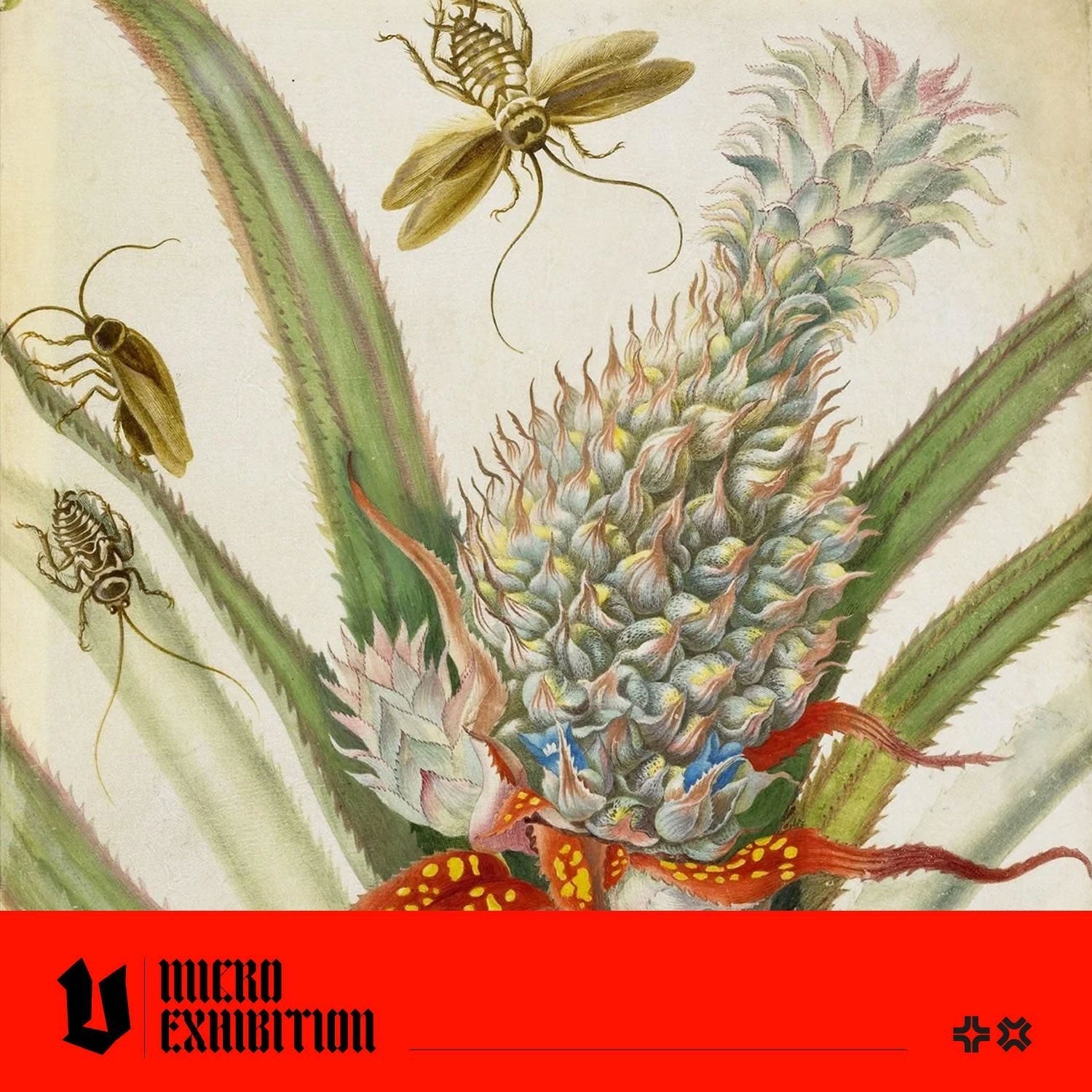
Maria Sibylla Merian, A Pineapple Surrounded by Cockroaches, 1701-1705 (circa)
Maria Sibylla Merian’s Early Life
Maria Sibylla Merian was born in Frankfurt, Germany in 1647 into a family that already had printing in its blood. Her father, Matthäus Merian the Elder, ran a dynasty of engravers and publishers, having taken over a firm originally founded by Theodor de Bry. The Merian workshop was famous for its lavishly illustrated volumes on European voyages to what they called ‘the New World ’, and their publications influenced how European readers pictured distant lands.
Her father died when Maria was three years old, and her mother married Jacob Marrell, a painter who encouraged her to draw and paint, a lifelong creative practice that turned into the precise, beautiful artwork she would become known for.
Her father died when Maria was three years old, and her mother married Jacob Marrell, a painter who encouraged her to draw and paint, a lifelong creative practice that turned into the precise, beautiful artwork she would become known for.

Portrait of Maria Sibylla Merian (1647-1717), by Jacob Marrell
From a young age, Merian was fixated on caterpillars. At thirteen, she began raising silkworms and quickly noticed that other caterpillars, not just silkworms, transformed into moths and butterflies. She spent the next five decades collecting, rearing, and documenting insects at every stage of their lives, first locally around Frankfurt and Nuremberg, and later, further afield.
Merian didn't work alone. Her daughters Johanna Helena and Dorothea Maria were trained as her assistants from childhood, and both went on to have their own careers as artists, with some of their work only recently being correctly re-attributed to them rather than their mother.

Maria Sibylla Merian, Plant with white trumpet-shaped flower, with two examples of a brown butterfly with a chrysalis, caterpillar, and smaller insects below, 1701-1705 (circa)
Merian’s Caterpillar Obsession and Scientific Discovery
In 1679, she published the first of a two-volume set on caterpillar metamorphosis, each volume containing fifty plates she had engraved and etched herself, documenting the life cycles of 186 European insect species alongside the specific plants they fed on.
It's important to clarify how strange Merian's approach was for her time. At this point, insects were widely believed to spring into existence through spontaneous generation, quite literally "born of mud."
It's important to clarify how strange Merian's approach was for her time. At this point, insects were widely believed to spring into existence through spontaneous generation, quite literally "born of mud."
Merian's meticulous observations of eggs hatching into larvae, larvae becoming pupae, and pupae emerging as moths and butterflies provided some of the clearest evidence yet that insects followed a predictable, traceable life cycle. She wasn't the only scientist working against this idea, but she was illustrating her scientific research at a time when women were barred by guild rules from even painting in oils (Merian painted with watercolours and gouache instead).

Maria Sibylla Merian, Caterpillars, from an album of 160 drawings entitled 'Merian's Drawings of European Insects'; with examples including a large orange caterpillar with turquoise spots, a green acorn below, 1691-1699 (circa)
The Voyage to Suriname
Merian's most famous chapter began in 1699, when she was 52. Having moved to Amsterdam, which was then the centre of European trade and scientific exchange, she found herself surrounded by stunning specimens brought back from the Dutch colonies. The idea for the trip itself seems to have grown out of her time with the Labadists, the strict religious community she'd lived alongside in the Netherlands, who briefly ran a plantation in Suriname. Through them, Merian would have heard firsthand accounts of the region's wildlife, which inspired her to visit as well.

Maria Sibylla Merian, Toucan holding a small bird in its mouth, 1701-1705 (circa)
At the time, this kind of journey was really only ever undertaken by men connected to the sugar trade, and it was considered hazardous even for them. A 52-year-old woman travelling with only her daughter for company was almost unheard of, with no royal funding and, by her own account, no named patron at all, Merian sold 255 of her own paintings to finance a voyage to Suriname, then a Dutch colony, on the northeast coast of South America, taking her younger daughter, Dorothea Maria, then in her early twenties, as her companion. She spent two years making repeated expeditions into the tropical interior, collecting specimens, feeding them, and sketching them as she waited for them to grow.

Maria Sibylla Merian, Water hyacinth, with examples of an insect, frog and another aquatic creature, one creature devouring a frog, with tadpoles and spawn, 1701-1705 (circa)
Her account of her travels is a historical document that describes both the scientific breakthrough and the colonial world she lived in. She found the work gruelling, and she relied heavily on the labour of enslaved people to cut paths through dense, thorn-choked forest so she could reach the insects and plants she wanted to study. She was openly critical of the Dutch colonists around her, who mocked her for showing interest in anything besides sugar.

Maria Sibylla Merian, Blue lizard and butterflies, depicting the life cycle of the insect, on a plant with star-shaped leaves, 1691-1699 (circa)
Merian’s Later Life and Legacy
An illness, likely malaria, forced her home in 1701. She returned to Amsterdam with sketches, pressed plants, dried insects, and various amphibian and reptile specimens, including a crocodile preserved in alcohol. Four years later, in 1705, she published Metamorphosis insectorum Surinamensium, a landmark volume of 60 engraved plates showing the region's insects alongside their host plants, complete with her own commentary on habitat and behaviour. It was the first book ever devoted entirely to Suriname, and it remains her most celebrated work.
Merian suffered a stroke in 1715 and died in Amsterdam in 1717, aged 69. Her influence stretched well beyond her lifetime: Carl Linnaeus later used her illustrations to formally describe dozens of species, and her work is credited with shaping generations of naturalist illustrators who followed. Her portrait appeared on the German 500 Deutsche Mark note before the country switched to the euro, Google marked her 366th birthday with a doodle in 2013, and in 2024, the Rijksmuseum acquired one of only 67 known surviving first editions of her Suriname book.
Regular readers of The Vault Zine might also recognise a familiar name in Merian's Amsterdam circle: the flower painter Rachel Ruysch, subject of one of our earlier profiles, became her pupil. Ruysch's father, the anatomist Frederik Ruysch, whom we've also written about, gave Merian access to his own extraordinary specimen collections, the same collections that so famously captivated Peter the Great. It's a small reminder of just how tightly connected this world of Amsterdam artists, anatomists, and collectors was.

Maria Sibylla Merian, Pink-flowered plant bearing small round fruit, with two examples of a brown and yellow butterfly with a black and white butterfly and two caterpillars and chrysalises, 1701-1705 (circa)