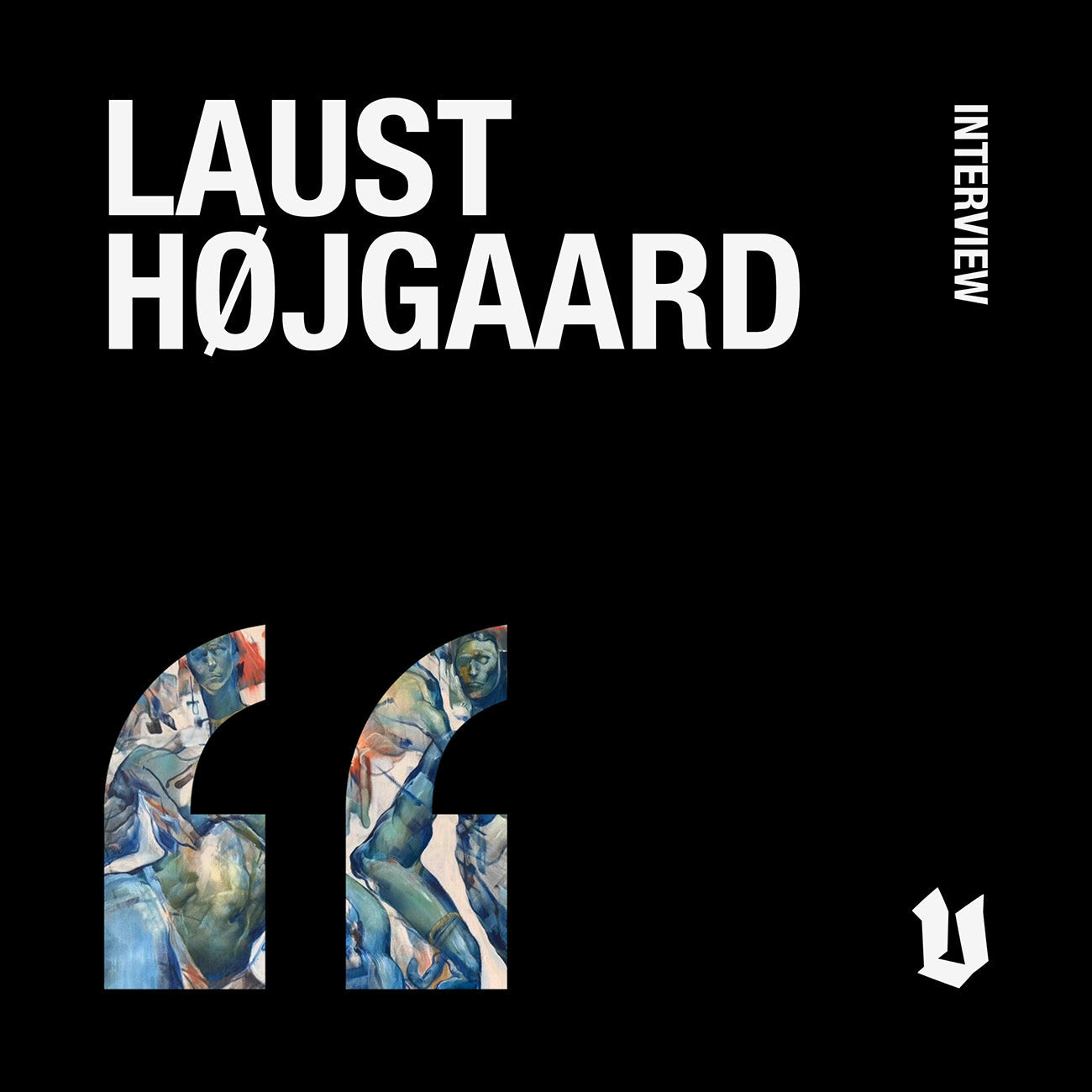
Laust Højgaard is a painter based in Svendborg, Denmark, whose work fuses mythology, pop, and urban culture into complex, layered compositions. Working on several canvases at once, he builds figures marked by exaggeration, distortion, and symbolic detail, creating bodies that carry both tension and movement. His practice is characterised by bold contrasts, irony, and depth, with influences ranging from classical references to street culture. A graduate of the Design Academy in Odense, The Drawing Academy, and the Danish School of Media and Journalism in Visual Communication, Højgaard continues to expand his universe across painting, sculpture, and beyond.

Laust Højgaard, Protégée, Acrylic on linen 195 x 195 cm, 2024
1. Hi Laust, thanks for joining us today; you work on several paintings at once, letting them resonate together. What does that simultaneous process give you that focusing on a single canvas can’t?
One of the main things I get from working on several canvases at once is that over the past couple of years, I’ve realized how crucial it is to keep myself curious. That curiosity is what keeps my momentum going. By jumping from piece to piece, I don’t get stuck in those little holes that can drag down the process. Instead, I can borrow a bit of energy or inspiration from another work, and I sort of float around between these different energy points. It makes the whole process more playful, which is really important to me. And if I’m working on a big piece, sometimes I just step aside and scribble on a smaller piece of paper or do a smaller artwork that doesn’t demand the same scale of attention. That way, I can keep things light and stay engaged.

Laust Højgaard, Phantom Mass Reduction, Acrylic on linen, 195 x 250 cm, 2024
2. You paint over your work and sometimes let paintings sit for months. What tells you a piece is finished, or that it needs to be destroyed and rebuilt?
Sometimes a piece just needs ten minutes, and other times it might need a whole year. Some works simply need time. I might walk past them for months, let them rest, or even hide them away completely so I don’t see them at all. Then, when I feel ready, I bring them back out. It might be about a certain feeling or energy I wasn’t able to access before, or something more concrete, like a color that clashes with the intention of the piece. I can’t always put my finger on what needs to change in the moment. It’s about returning to the work when I have the mental space to really deal with it.

Laust Højgaard, Verge of Transcendence, Acrylic on canvas. 200 x 150 cm, 2025
3. You’ve said intuition is key in your work, and that it’s not about perfection or beauty. How do you keep intuition at the forefront of your practice?
Perfection sounds like a very concrete idea, but in an artistic process, it can be incredibly limiting. I’ve experienced that myself. Once I realized that perfectionism was holding me back, and that authenticity for me lives in expression and energy rather than surface-level ideas of what’s “right,” it was a huge mental shift. Intuition is tied to emotion, not rules. Craft is important—you need it to be able to create what you imagine—but once you have that, it needs to sit in the background. I let the emotional side guide what happens on the canvas. That’s where the work becomes alive for me.
 Laust Højgaard in the studio
4. You’ve started exploring sculpture and 3D work. What have you discovered about translating movement from paint into physical form?
It’s actually something I’ve always worked with in a way, and it’s given me a strong understanding of form. I see it all as the same thing. Even when I paint, I’m thinking in terms of pulling, pushing, and carving, just like I would in 3D. The tools and the medium change, but my understanding of what I’m creating doesn’t. To me, it doesn’t really matter whether it’s two-dimensional or three-dimensional—it’s all about shaping an idea.

Laust Højgaard, Vessels, Acrylic and oil on linen, 77 × 63 in, 2024
5. You’ve said that balance isn’t necessarily the goal and that tension is important. How do you decide which contrasts to lean into?
For me, creating something beautiful doesn’t mean it’s smooth or free of struggle. Beauty is full of contrasts and tensions. I borrow a lot from nature—organic shapes, colors, and forms—where everything is constantly interacting. I want melancholy, joy, humor, energy, stillness, weight, and lightness to exist side by side. The result isn’t meant to be one pure emotion. It’s about reflecting the mix of feelings I’m in while I’m working. That complexity is what I find beautiful.

Laust Højgaard, Captive Trajectory, 64 x 46 cm, Acrylic and Oil on Linen, 2025
6. You returned to painting after a long break and began sharing work anonymously online. What did that process give you?
I wouldn’t recommend it universally, because every artist is in a different place. But for me, at that time, anonymity removed the pressure. I wasn’t accountable to anyone. I was doing it purely for myself, while still allowing others to look in if they wanted to. The fact that it resonated with people was incredibly affirming, but that wasn’t the goal. What mattered was that it helped me feel safe and confident in what I was making. That sense of security has stayed with me, even after putting my name on the work.

Laust Højgaard, Weight of Legends, 60 x 50 cm, Acrylic and Oil on Linen, 2025
7. When you feel pressure or perfectionism creeping back in, how do you protect your process?
I’ve developed different ways of entering a work so I can stay intuitive and avoid external expectations. That might mean changing format or scale, starting with a different color, beginning abstract and forcing it to stay abstract, or doing the opposite—starting very figurative and then pushing it into abstraction. I use exercises like blind drawing or other strategies that help me surprise myself and sort of sneak into the work through the back door. I don’t struggle with it as much anymore because I have these tools. My rule is simple: don’t sit and stare at a blank canvas. Just start. And if it turns out bad, move on. The most important thing is not to stop.

Laust Højgaard, Sankofa, 60 x 60 cm, Acrylic and Oil on Linen, 2025
8. You recently worked on carving tiles for the Walk of Fame in Istedgade, Copenhagen. Can you tell us about that project?
The project honored homeless people connected to an organization called Gadens Stemmer, who give guided tours of Copenhagen based on their personal stories. This Walk of Fame was meant as a counterpoint to the traditional version—it focused on people who often don’t get much attention, but who contribute deeply meaningful stories to the city. It was incredibly important to me, and I felt very honored to be invited.
Working with stone after years of painting was fascinating. It brought me back to the drawn line and made me reflect on how my thinking has evolved from color fields to outlines and form. It’s the same shapes, just expressed through a different technique. What really struck me was that the final work is embedded in the sidewalk itself—something people walk on, something exposed to weather and time. The story becomes part of the street it belongs to, and that feels incredibly powerful.
Laust Højgaard, Broken Emblem, 40 x 30 cm, Acrylic and Oil on Linen, 2025
9. Is there a book that has had a lasting impact on you?
Christian Rex van Minnen is a huge star in my world. His book Massa Confusa, which I’ve owned for several years, includes complete masterpieces. I keep getting drawn back into his work. It’s deeply rooted in historical references, but at the same time, it looks forward. It really sparks something in me, and it’s influenced how I feel allowed to move and think within my own artistic practice.

Laust Højgaard, Chrono Drift, 80 x 80 cm, Acrylic and Oil on Linen, 2025
Thank you for chatting with us today Laust. It’s been a pleasure to learn about your practice and we’re very excited to see what you create next!
Laust Højgaard, Untitled, 195 x 250 cm, Oil and Acrylic on linen, 2025
LEARN MORE ABOUT LAUST’S WORK:

Laust Højgaard, Failed Hero, 140 x 100 cm, Acrylic and Oil on Linen, 2025